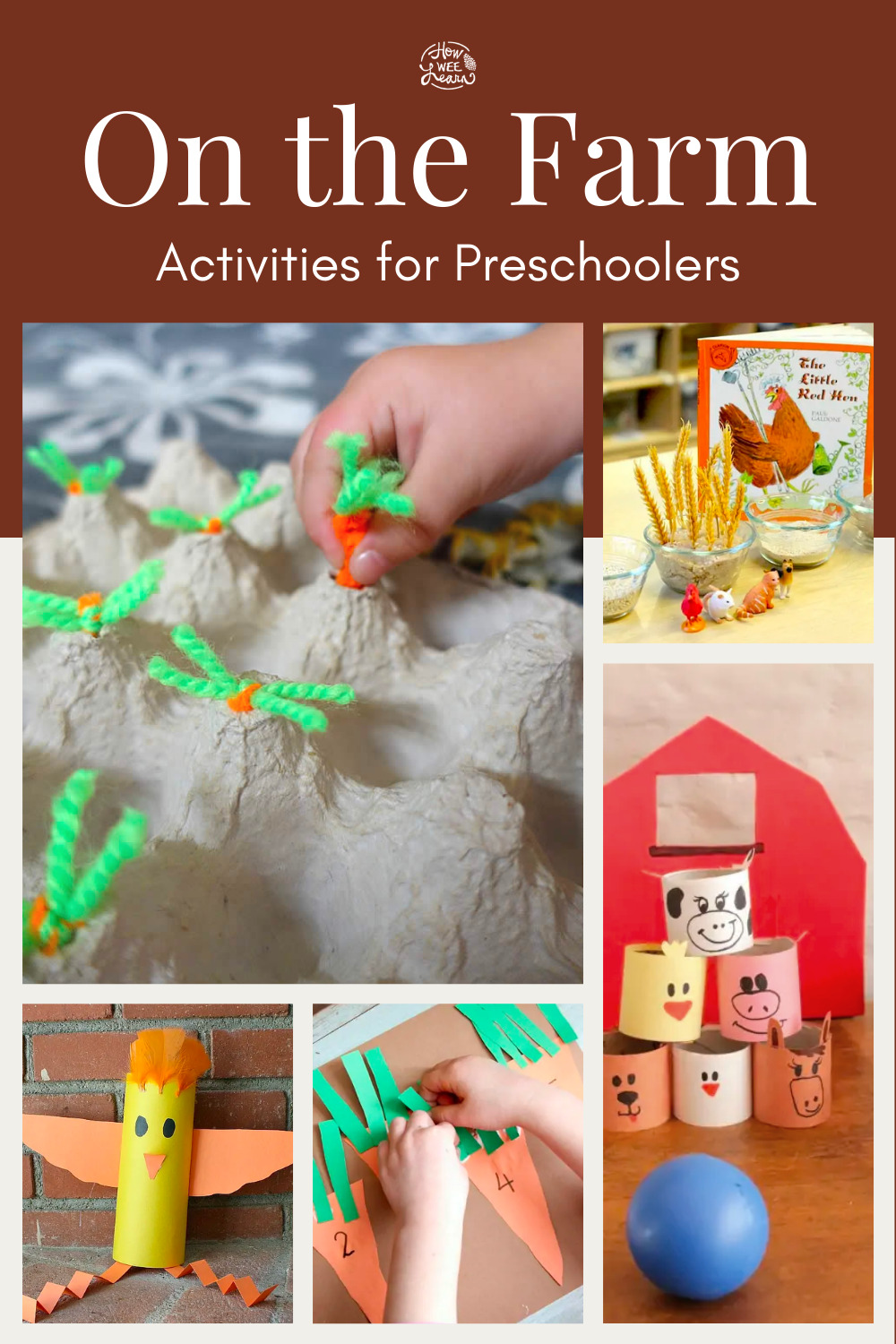
Farm Activities for Preschoolers: 15 Hands-On Ideas by Skill
A farm theme is one of the easiest topics to build a week of preschool learning around, because farm animals, food and machines are already familiar to most children aged 3 to 6.
The fifteen activities below are grouped by what they actually develop: senses, motor skills, craft, language and cooking. Each one lists what it teaches and what you need, so you can pick by the skill you want to work on rather than by what looks fun.
Sensory farm activities
Start here with the youngest children. Sensory work needs no pencil control and no reading.
Farmyard texture tray
Fill a shallow tray with straw, dried corn, wool scraps and smooth pebbles. Let your child sort them by how they feel rather than by what they are.
What it teaches: Descriptive language for texture, and early sorting by a single attribute.
You will need: Shallow tray, straw, wool, dried corn.
Scented herb garden pots
Put mint, rosemary and lavender in separate pots. Ask your child to close their eyes, smell one, then find it again by scent alone.
What it teaches: Smell discrimination and the vocabulary to describe it.
You will need: Three potted herbs.
Farm sound hunt
Play recorded farm sounds one at a time. Your child runs to a picture of the animal or machine making it.
What it teaches: Listening discrimination, which underpins later phonics work.
You will need: Sound clips, printed animal pictures.
Motor skill activities
Planting seedlings
Give your child a small pot, compost and one bean seed. Making the hole, dropping the seed and covering it are three separate fine motor movements.
What it teaches: Pincer grip and sequencing a three-step task.
You will need: Small pots, compost, bean seeds.
Watering with a small jug
Pour water from a jug into narrow pots. Narrower pots make it harder, so start wide and reduce the target.
What it teaches: Wrist control and judging quantity.
You will need: Small jug, pots, water.
Feed the animals scoop and carry
Scoop dried oats into a bucket and carry it across the room to a toy animal without spilling. Add distance as they improve.
What it teaches: Gross motor control and balance while carrying a load.
You will need: Scoop, bucket, dried oats.
Farm crafts
Woolly sheep collage
Draw a sheep outline and let your child glue cotton wool inside the line. Staying inside the outline is the actual exercise.
What it teaches: Boundary awareness, which transfers directly to letter formation.
You will need: Paper, cotton wool, glue.
Vegetable stamp printing
Halve a potato, carrot and pepper. Dip in paint and print rows. A pepper prints a surprising flower shape, which is usually the moment they get interested.
What it teaches: Prediction, and noticing that a cut surface has a pattern.
You will need: Vegetables, paint, paper.
Farm map puzzle
Draw a simple farm on card, cut it into six pieces, then have your child rebuild it. Six pieces suits a three-year-old; go to twelve for a five-year-old.
What it teaches: Spatial reasoning and part-to-whole thinking.
You will need: Card, pens, scissors.
Language and story activities
Barnyard read-aloud with sound effects
Read any farm story and give your child one animal to voice. They have to listen for their cue, which keeps attention on the text.
What it teaches: Listening for a cue and following a narrative.
You will need: Any farm picture book.
Paper bag animal puppets
Make two or three puppets, then act out what happens on the farm in a day. Let your child decide the order of events.
What it teaches: Sequencing and retelling in their own words.
You will need: Paper bags, pens, scraps.
Old MacDonald with substitutions
Sing the song, then swap in animals that are not usually on a farm and let your child correct you. Being right is the fun part.
What it teaches: Category boundaries, what belongs to a farm and what does not.
You will need: Nothing.
Farm cooking activities
Cooking connects the farm to the table, which is the part most children have never thought about.
Bread from flour
Make a simple dough and let your child knead it. Talk about wheat becoming flour becoming bread while they work.
What it teaches: Where food comes from, and hand strength from kneading.
You will need: Flour, yeast, water, salt.
Butter in a jar
Half fill a jar with double cream, seal it, and shake. It becomes butter in about ten minutes of shaking, and the moment it turns is genuinely surprising.
What it teaches: Cause and effect, and persistence toward a visible result.
You will need: Jar with a tight lid, double cream.
Harvest salad
Let your child wash and tear salad leaves and count out cherry tomatoes. Tearing is safer than cutting and still builds hand strength.
What it teaches: Counting with a purpose, and food handling.
You will need: Salad leaves, tomatoes, bowl.
Print the checklist
One page with all 14 ideas and a box to tick as you work through them. A4, free to print.
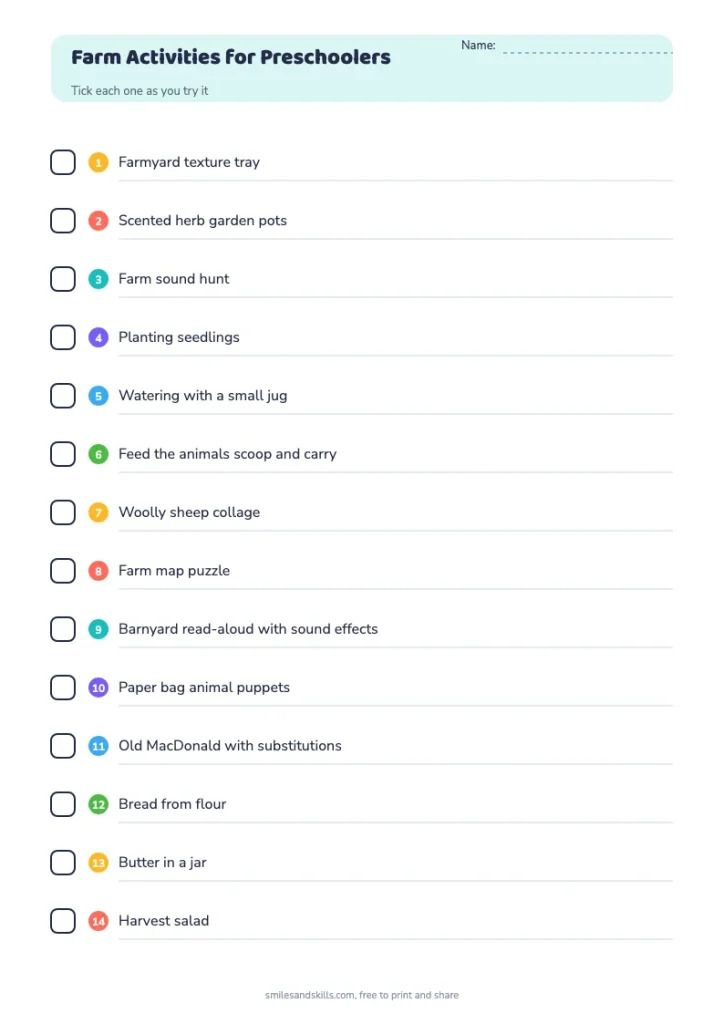
Download the farm activities for preschoolers checklist (PDF)
Frequently Asked Questions
What should I teach preschoolers about farms?
Three things carry most of the value: which animals live on a farm, what each one gives us, and where the food on their plate came from. That last one is the connection most children have never made.
How do I make a farm sensory bin?
Use a shallow tray with dried corn or oats as the base, then add small toy animals, a scoop and a small bucket. Keep the base material to one type at first, because too many textures at once is overwhelming for a three-year-old.
What age are farm activities suitable for?
The sensory and craft activities work from about two and a half. Planting, cooking and the puzzle work better from four upward, mostly because they need more patience than dexterity.
What do farm animals give us?
Cows give milk, which becomes butter and cheese. Chickens give eggs. Sheep give wool. Bees give honey and pollinate the crops. Naming the product alongside the animal is what makes the theme stick.
More theme activities
Other themes that work the same way: Ocean activities for preschoolers, Police theme activities, Zoo animal crafts.