Healthy Eating Habits for Preschoolers: A Practical Guide
Healthy eating for a preschooler is less about nutrition charts and more about the habits formed between ages 3 and 6, when food preferences and mealtime behavior are still being set.
The short version: eat together where you can, offer new foods repeatedly without pressure, keep portions small, and let your child decide how much of what you serve they eat. The sections below cover each of those, and what to do when it is not going well.
Setting up mealtimes
The environment does more work than the menu at this age.
Eat at the same table, at the same time
Sit down together for at least one meal a day, with the screen off. Children eat a wider range of foods when they see adults eating them.
What it teaches: Eating is social, and new foods are normal rather than a test.
You will need: Nothing beyond the decision to do it.
Serve small, offer seconds
Put a small amount on the plate and let your child ask for more. A large plate reads as a demand to a four-year-old.
What it teaches: Recognizing their own fullness instead of clearing a plate.
You will need: Smaller plates.
Separate your job from theirs
You choose what is offered and when. Your child chooses whether to eat and how much. Holding that line removes most mealtime arguments.
What it teaches: Trust in their own appetite, which reduces later overeating.
You will need: Nothing.
Introducing new foods
Offer it again, without comment
A child may need to see a food ten or more times before trying it. Put it on the plate, say nothing about it, and remove it without remark if untouched.
What it teaches: Familiarity, which is what actually drives acceptance.
You will need: Patience across several weeks.
Pair new with known
Serve one unfamiliar food alongside two your child already eats. A plate of entirely new food is usually refused on sight.
What it teaches: That a new item is an addition, not a replacement.
You will need: Nothing.
Let them handle the food raw
Washing, tearing and sorting vegetables before they are cooked makes them familiar objects rather than unknown items on a plate.
What it teaches: Reduced novelty, plus fine motor practice.
You will need: Raw vegetables, a bowl.
When your child is a picky eater
Some fussiness between two and five is developmentally normal and usually passes.
Do not make a separate meal
Offer one meal with at least one component you know your child will eat. Cooking a second dinner teaches that refusing produces a better option.
What it teaches: That the meal on the table is the meal.
You will need: Nothing.
Drop the pressure and the reward
Avoid both “three more bites” and “pudding if you finish”. Pressure and bribery both reduce how much a child ends up liking the food itself.
What it teaches: Eating for hunger rather than for approval.
You will need: Nothing.
Watch the drinks
Milk and juice between meals fill a small stomach and blunt appetite. Water between meals, milk with them.
What it teaches: Arriving at the table hungry, which solves a surprising amount.
You will need: Water cups.
Snacks that work
Two planned snacks a day
Set snack times rather than grazing on demand. Constant grazing is the most common reason a child will not eat dinner.
What it teaches: A predictable hunger rhythm.
You will need: A rough daily schedule.
Pair a protein with a carbohydrate
Apple with cheese, toast with peanut butter, yoghurt with fruit. The pairing keeps them full until the next meal.
What it teaches: That snacks are small meals, not treats.
You will need: Basic fridge staples.
Let them build it
Offer three or four components and let your child assemble their own plate. Choice at snack time reduces conflict at mealtimes.
What it teaches: Decision making within limits you set.
You will need: Small bowls of components.
Print the checklist
One page with all 12 ideas and a box to tick as you work through them. A4, free to print.
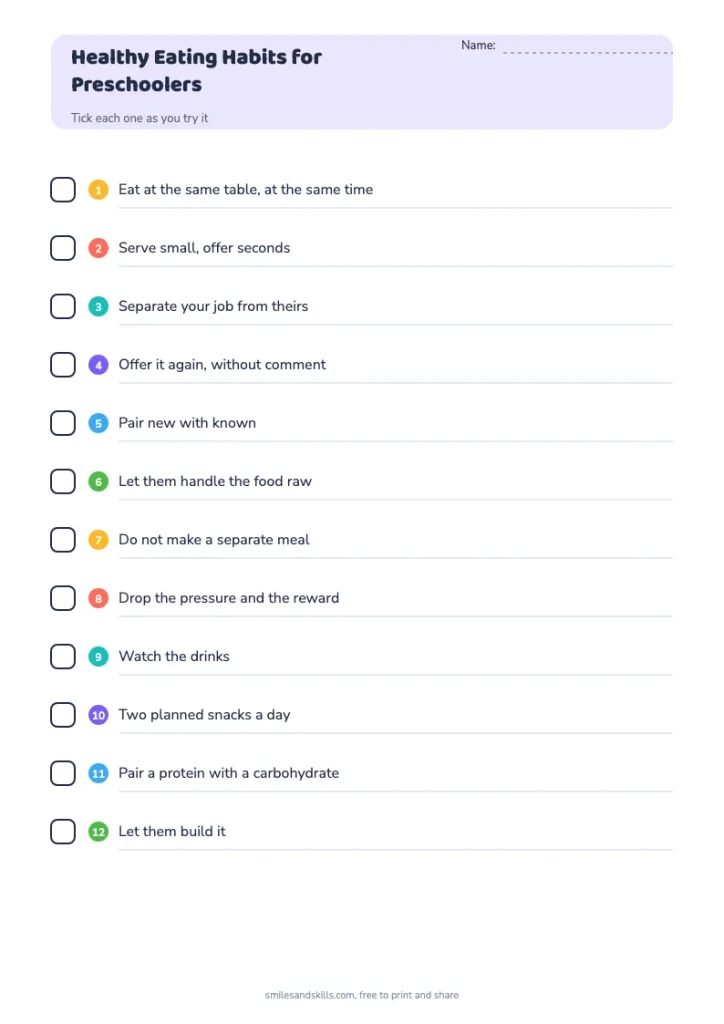
Download the healthy eating habits for preschoolers checklist (PDF)
Frequently Asked Questions
How do I encourage healthy eating without a fight?
Separate the roles. You decide what is offered and when, your child decides whether and how much. Most mealtime conflict comes from adults taking on the second job as well as the first.
How many times should I offer a food before giving up?
Ten or more exposures is common before a child accepts a new food, and each exposure should be low key. Offering it twice and concluding they dislike it is the usual mistake.
What are good snack ideas for preschoolers?
Anything pairing a protein with a carbohydrate: cheese and apple, yoghurt and berries, wholemeal toast with nut butter, hummus with cucumber. Two planned snacks a day works better than open grazing.
How can I get my child to drink more water?
Keep a reachable cup of water available all day and offer it at every transition, after play, before a story, after being outside. Removing juice from between meals does more than encouraging water does.
Related activities
Activities that support the same habits: Nutrition activities for preschoolers, Dental activities for preschoolers.