Math Activities for Preschoolers: 12 Simple Ideas
Early math for children aged 3 to 6 is mostly counting, sorting, comparing and spotting patterns, well before any written numbers are involved.
The twelve activities below need almost no equipment and are grouped by the skill each one builds. Counting is where to start if you are not sure, because everything else depends on it.
Counting
Reciting numbers and counting objects are different skills. The second is the one that matters.
Touch and count
Count objects while physically touching each one. If your child counts faster than they touch, slow them down and start again.
What it teaches: One-to-one correspondence, the foundation of all counting.
You will need: Any small objects.
Count the stairs
Count out loud going up and down the stairs every time. Repetition in a fixed context builds the sequence quickly.
What it teaches: The counting sequence, and that it works backwards too.
You will need: Stairs.
Snack time counting
Ask for a specific number of items rather than a vague amount. Four grapes, then two more, then count the total.
What it teaches: Counting on from a number, rather than restarting at one.
You will need: Snacks.
Sorting and comparing
Sort the laundry
Sort socks by color, then re-sort the same pile by size. Doing two sorts on one pile is what makes the point.
What it teaches: That things can be grouped in more than one way.
You will need: Clean laundry.
Bigger, smaller, same
Hold up two objects and ask which is bigger. Include pairs that are the same size, because that answer is often not offered.
What it teaches: Comparison language and that equal is a valid answer.
You will need: Two of anything.
Line them up by height
Order five toys from shortest to tallest. Five is enough, and adding a sixth mid-task is a good extension.
What it teaches: Ordering by a single attribute.
You will need: Five toys.
Shapes and space
Shape hunt round the house
Look for circles, squares and triangles in ordinary objects. A clock, a window, a slice of pizza.
What it teaches: Recognizing a shape independent of size and color.
You will need: Nothing.
Build it from sticks
Make shapes from lolly sticks or dry spaghetti. Ask how many sticks each shape needed.
What it teaches: That a shape is defined by its number of sides.
You will need: Lolly sticks.
Follow the map
Draw a simple room plan with an X, and let your child find the spot. Then let them draw one for you.
What it teaches: Spatial reasoning and reading a representation.
You will need: Paper and a pen.
Patterns and measuring
Start a pattern, let them continue it
Lay out red, blue, red, blue and pause. Once that is easy, move to red, red, blue.
What it teaches: Recognizing and extending a repeating unit.
You will need: Two colors of anything.
Measure with feet
Measure the room in your child’s footsteps, then in yours, and talk about why the numbers differ.
What it teaches: That measuring needs a consistent unit.
You will need: Nothing.
Water pouring and capacity
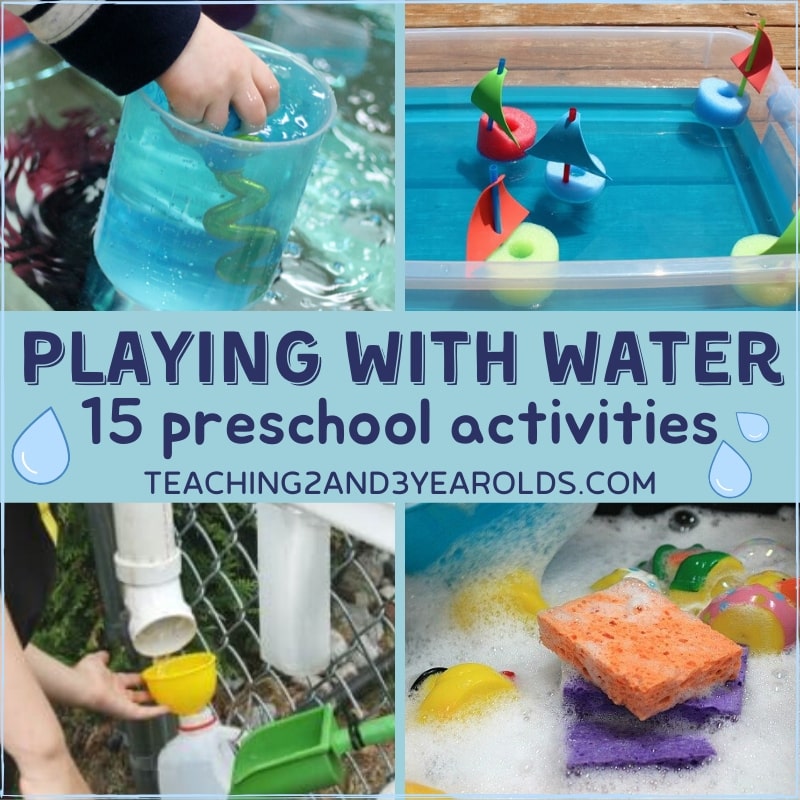
Pour between different containers and ask which holds more. A tall narrow glass beside a short wide one is the useful case.
What it teaches: That taller does not always mean more, which is a genuine leap.
You will need: Assorted containers, water.
Print the checklist
One page with all 12 ideas and a box to tick as you work through them. A4, free to print.
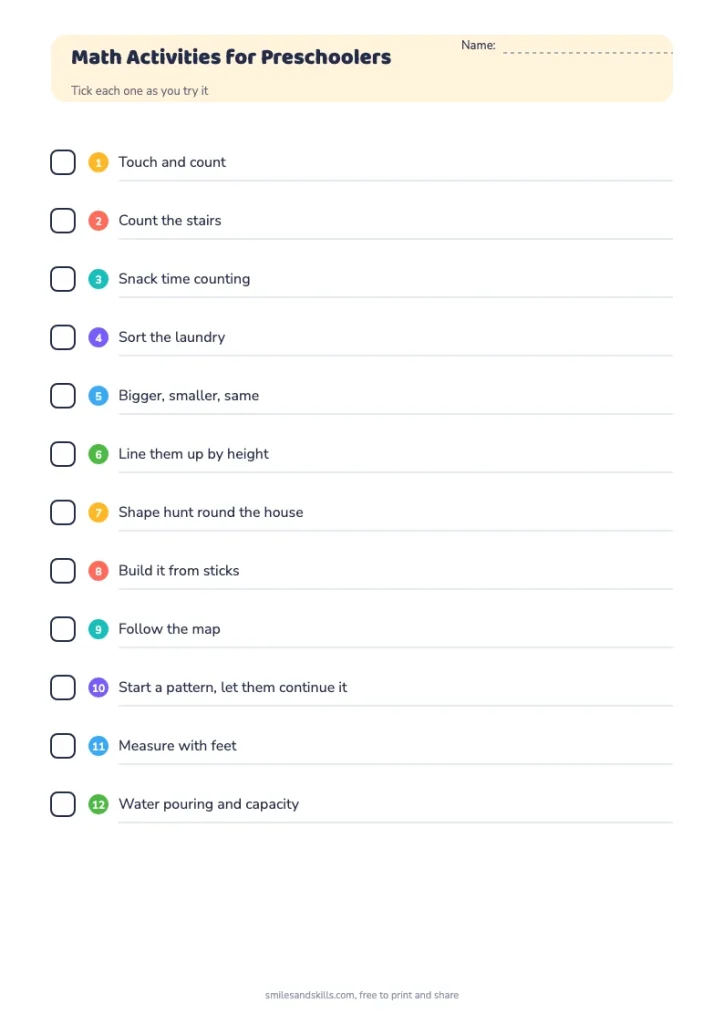
Download the math activities for preschoolers checklist (PDF)
Frequently Asked Questions
What math should a preschooler know?
By about five, most children can count objects reliably to ten, recognize basic shapes, sort by one attribute and continue a simple pattern. Written sums are not expected at this stage.
How do I teach math through play?
Attach the counting to something real, stairs, snacks, socks, so the number has a purpose. Math done as a worksheet at three has much less effect than math done while doing something else.
What materials are best for preschool math?
Household objects beat bought resources for this age. Buttons, pasta, socks, cups and lolly sticks cover counting, sorting, patterns and shape between them.
My child can count to twenty but miscounts five objects. Why?
Reciting the number sequence and counting a set are separate skills. Practice touching each object while saying its number, which is the part that is missing.
Related activities
More counting and shape work: Counting with butterfly wings, Oval activities for preschoolers, Pattern activities for preschoolers.
If you would rather work from a sheet, Preschool Activities Worksheets explains what makes a worksheet usable at this age.