Vocabulary Activities for Preschoolers: 12 Games
Vocabulary is the number of words a child understands and uses, and it is the single strongest predictor of how easily they will learn to read later.
Children learn words from conversation and repetition far more than from instruction. The twelve games below build vocabulary through play, grouped by whether they use talk, movement, objects or stories.
Talking games
The most effective vocabulary work looks like ordinary conversation with slightly harder words in it.
Say it the long way
When your child says a simple word, repeat their sentence back with a richer one. They say “big dog”, you say “yes, an enormous dog”. No correction, just the better word offered.
What it teaches: Synonyms and shades of meaning, without it feeling like a lesson.
You will need: Nothing.
Twenty questions with objects
Hide an object and let your child ask yes or no questions to find out what it is. They quickly learn they need describing words to narrow it down.
What it teaches: Attribute words, and asking a useful question.
You will need: Any household object.
Finish my sentence
Start a sentence and stop before the last word. Let your child supply it, then ask for a second option.
What it teaches: That more than one word can fit, which is where vocabulary depth comes from.
You will need: Nothing.
Movement games
Charades for action words
Act out verbs and let your child name them. Push past the obvious ones into stumble, creep, dash and hop.
What it teaches: Verbs, which most children have far fewer of than nouns.
You will need: Nothing.
Simon says with unusual verbs
Play as normal but use less common instructions: balance, stretch, tiptoe, crouch. The game forces them to work out the meaning from context.
What it teaches: Following instructions and inferring meaning.
You will need: Nothing.
Position word treasure hunt
Hide something and give directions using under, behind, between, beside and above. Then swap and let them direct you.
What it teaches: Prepositions, which are hard to teach any other way.
You will need: A hidden object.
Object and sorting games
Feely bag descriptions
Put an object in a cloth bag. Your child describes what they feel before guessing, and is not allowed to guess first.
What it teaches: Texture and shape words, and describing before concluding.
You will need: Cloth bag, small objects.
Odd one out
Put out four objects where three share a property. Ask which does not belong and, more importantly, why.
What it teaches: Category words and justifying a choice.
You will need: Four household objects.
Matching pairs with a twist
Play memory pairs, but the child has to say what the picture is before the card counts as turned over.
What it teaches: Word recall under mild time pressure.
You will need: Picture cards.
Story and book games
Stop and wonder
While reading, stop at one unfamiliar word per page and explain it in a short phrase. One word per page is enough.
What it teaches: New words anchored in a story, which is how they stick.
You will need: Any picture book.
Retell it wrong
Retell a familiar story with deliberate mistakes and let your child correct you. Being the expert is the motivation.
What it teaches: Close listening and precise correction.
You will need: A well known story.
Word of the day
Pick one word each morning and use it as often as you reasonably can. Your child gets to catch you using it.
What it teaches: Repetition in varied contexts, which is what fixes a word.
You will need: Nothing.
Print the checklist
One page with all 12 ideas and a box to tick as you work through them. A4, free to print.
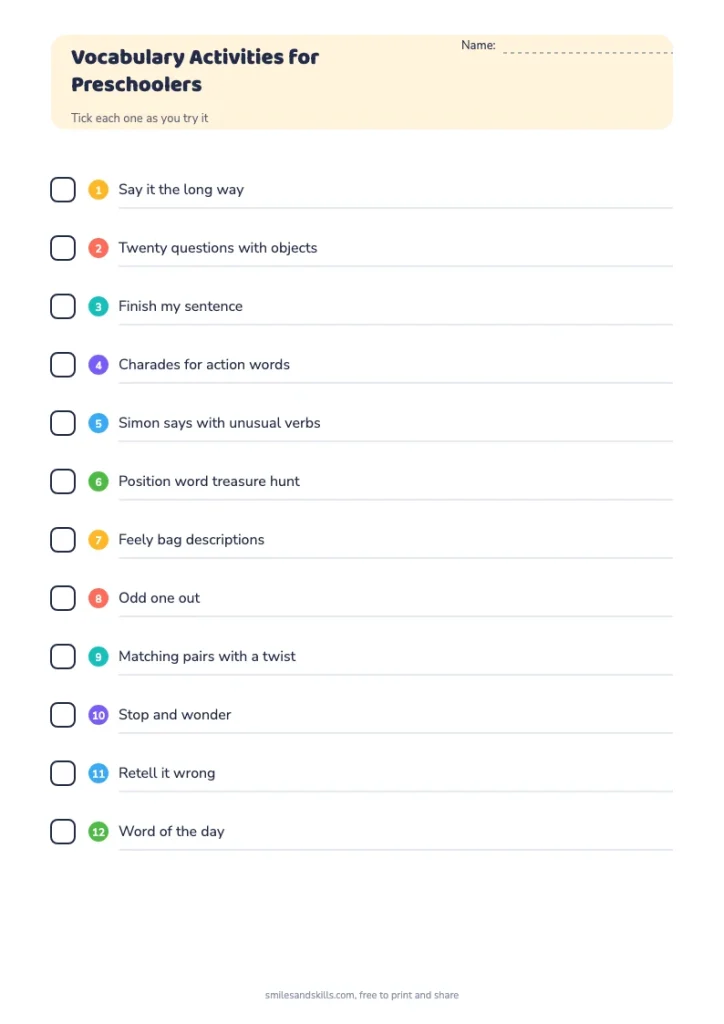
Download the vocabulary activities for preschoolers checklist (PDF)
Frequently Asked Questions
How many words should a preschooler know?
Ranges vary widely and comparisons are rarely useful. What matters more is that the number is growing and that your child is hearing plenty of conversation directed at them.
What builds vocabulary fastest at this age?
Talk and shared reading. Both work because they put new words in a context the child can use to work out the meaning, which a word list cannot do.
Does screen time help vocabulary?
Far less than conversation. Children learn words most reliably from a person who responds to them, because the back and forth is what carries the meaning.
My child understands more than they say. Is that a problem?
No, understanding normally runs ahead of speaking throughout the preschool years. Persistent concerns about speech are worth raising with a health visitor or teacher.
Related word learning
Word lists and letter work that pair with these games: Animals that start with B, Letter D activities, Name activities for preschool.
Vocabulary is one part of a wider picture, and Language Activities for Preschoolers: Boost Early Skills! covers listening and speaking alongside it.